July 5, 2014

Day 4: São Miguel Road Trip, West & Northwest

I’m not keen on guided tours, but decided it would be silly to only stay in town and not see the rest of the island. And I want to be able to stop and record at any place that seems promising, and stay as long as I need to. So today, after some initial trepidation and procrastinating, I rented a car. Not sure why I feel intimidated about driving here, it’s really no different. And it’s an island, so getting lost is not an issue. But I bought the full insurance, just in case. Once I got out on the road the driving was fine and I had a great day. Went up a winding mountain road to Lagoa do Canário (Canary Lake) where I recorded birds in the pine/fern forest, and young campers singing songs as they marched on a hike to somewhere.


Then to Sete Cidades (Seven Cities), where there are two lakes next to each other in a volcanic crater — one green, one blue. Very famous place, lots of tourists at the scenic overlooks, and lots of hikers on the surrounding trails. Drove down into the caldera, through the town by the lakes, and up the other side then back down to the coast.


The coastline is really rugged and beautiful, reminds me a bit of Northern California except all the rocks are lava and the beaches are black sand.
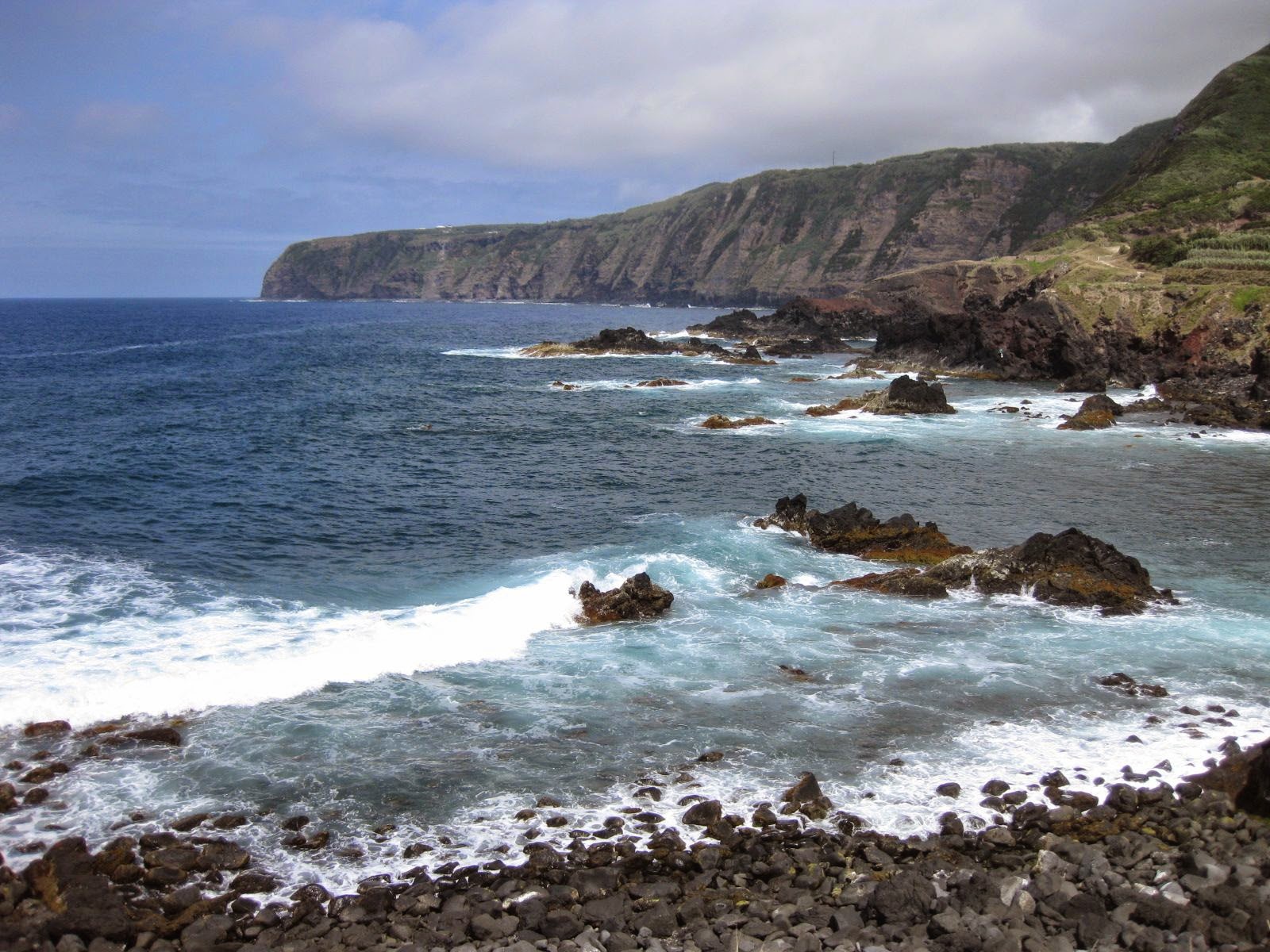

I stopped in Mosteiros and made some good recordings of pounding surf, and drove all the way to Capelas on the north coast and then back to town, basically a loop of the whole west/northwest part of the island. A lot of the little coastal towns have natural swimming pools, which are like large tide pools where the ocean comes in, but protected from the waves by large rocks that form a kind of lagoon. Some are definitely man-made, some seem to be more natural, but they are really great and quite popular with local people. Haven’t swum in one yet, but hope to soon.


I should also mention that I seem to have arrived during the peak bloom time for the hydrangeas, which are literally everywhere you look and line all of the roads.


In the evening I was invited to a party at the modern beach house of João and Diana, out on the north coast near Capelas, where I had been on my drive earlier in the day. Lots of interesting folks of many nationalities there — German, Swede, Brit, American, but mostly Portuguese. Everyone brought good food and wine and there was interesting bilingual conversation. I met some other musicians and artists and had a great time, and our gracious hosts made me feel welcome. Everyone knew everyone, and I got a sense of what a small, tight community this is. Emanuel’s oldest daughter was there with her guy and their cute little girl, Violeta. João was talking to this woman from England in a perfect Scottish accent; turns out he grew up in Edinburgh, and can whip out the accent whenever he talks to someone from Britain. Talking to me, he speaks English with a much more "Portuguese" accent. Really funny. At one point João and Diana’s daughter Emma (maybe 12?) started playing her beginner’s cello exercises. One of the male guests started singing with her, improvising on what she was playing, very witty and fun. Emma really got into it, and the weirder his improvisations got, she was right there with him, playing skronky sound effects on the cello. I was so impressed by her adventurous playing. Then the rest of the adults joined in on kitchen percussion and dancing, and it was quite amusing. One of the other guests was the American jazz drummer Michael Wimberly, who is here from NY to do some workshops with kids — very nice guy, I didn't know him before but we know some people in common. He had a gig later that night and I wanted to go, but I was too tired so got dropped at the hotel instead.

July 4, 2014

Day 3: Ponta Delgada

I met with Rafael Carvalho in his office at the conservatory at 9 AM to do some recording before the students arrived and it would get too noisy. Got some potentially useful material, though no idea yet how I’ll use it. It's a beautiful instrument, with lots of significant symbolism built into the design.


The twin sound holes are heart-shaped tears, representing the saudades of the people who leave the islands and those of the people who stay behind. The thread that connects the two is also in the shape of the crown, an image used in the Espirito Santo (Holy Ghost) festivals that are mostly an Azorean thing and still occur in the US and Canada as well. The ends of the tailpiece, where the strings attach, are the heads of a kind of kite that lives here and was originally mistaken for a hawk, giving the islands their collective name (açores = hawks). The inlay at the bottom represents the crops that people grow here, and their close ties to the land.


Rafael was very patient with me, and we recorded some variations on the desafio music, a very typical piece called Saudade, and one of his originals. He refused to let me pay him for his time. A great musician, and a really sweet, bright guy who is easy to hang out with.


After our recording session, I spent the rest of the day wandering the city, making more recordings, getting a better sense of where I am and where things are. Went to the public market near the conservatory. Found a good book store where I bought a book of (I think) very beautiful short poems that I can translate without too much trouble, "As Palavras do Silêncio" (The Words of Silence) by Joaquim Castilho. My kind of title.


July 3, 2014

Day 2: Ponta Delgada

Today Emanuel arranged a meeting for me with Duarte Melo, the director of the museum where she works. Very nice guy, open and friendly. He is also a priest. I tried to explain what I'm doing in my remedial Portuguese, Emanuel helped translate, we spoke some Spanish to fill in the gaps, and it felt like it was a good meeting. He seems interested in the project, encouraging, might not be able to present it at his museum but had ideas for other places and offered to help me make connections if I want to present the finished work here in the future.

Emanuel took me to lunch in the cafeteria at the library, which is good and cheap. There was also a good exhibit there of cast iron book sculptures by an artist named Ricardo Lalanda.


Then I walked around town some more, just exploring. The Museu Carlos Machado has several buildings, one of which is an amazing 16th century church that has a very good collection of religious art. Their main building is currently closed for renovations, but there was an interesting show in their smaller space of curated pieces from their collection, including this famous painting (relevant to my research) and this incredibly beautiful tool (also relevant, now that I think of it). Hard to tell from the photo, but in person it just killed me. Beautifully rusted iron blade, and handle worn from many hands and years of use, with a coin nailed onto the end of the handle.

There are many bell towers here, which of course I love. I managed to climb the one in the Camara Municipal, built in 1724, which offers a fine view of a couple of others.


Made some recordings in a botanical park of kids playing and birds. Really good birds here, though I don’t know names, but they make great sounds.


In the evening Emanuel invited me for a dinner with some friends of hers at a seafood place in a small village on the north coast, east of Ribeira Grande. All very friendly, smart, and interesting folks: João and Diana, a couple from here who are involved with music and literature and theater, and another couple visiting from Lisbon, Luisa and Zé Miguel. The food was terrific: a fish soup, limpets with rice and veggies, fava beans, fish stew with four different kinds of fish (no idea what), hot bread, pastries, and a few bottles of wine. Everyone made a point of speaking English on my behalf, which I appreciated, although I was happy when they spoke Portuguese. I can pick out a few words here and there and piece together the basics, and don’t really mind that I miss a lot and have only a vague (often completely wrong) notion of what is being said. Listening is learning.

July 2, 2014

Day 1: Ponta Delgada & Ribeira Grande

I'm spending my first week in Ponta Delgada, the capital city of the Azores on the southern coast of the largest island, São Miguel. It's the largest city in the islands, and in some ways the most cosmopolitan and accessible — a good place to land for first-time visitors, as many people speak English quite well and there are plenty of places to stay and eat and things to do: hiking trips, whale watching, museums, theaters, art galleries, book stores, yoga classes, a nice waterfront promenade along the harbor, some good parks, a large public/farmers market, etc. There's a good vegetarian restaurant, a couple of jazz clubs, and a good library. On the other hand, you can walk from one end of town to the other in an hour or so, at a leisurely pace. Narrow streets that all lead to the water or run parallel to it. Pretty hard to get lost here.

I’m in a very basic, small hotel: simple and clean, with friendly and helpful staff, great location in the older part of town, within easy walking distance of everything. It's on what looks like a narrow, charming, “quiet” street, but is in fact quite busy with traffic. There's a bakery a few doors down that smells wonderful, but they start loading their delivery trucks around 4 AM. There is also a fair amount of random shouting and swearing (?) in the middle of the night by possibly crazy and/or drunk guys in the street. So sleeping has been tricky, in addition to jet-lag and being in a strange bed.

My entry here has been made much easier by a couple of internet acquaintances. A few years ago, a record label in Lisbon released a CD of mine. I asked Paulo Raposo, the guy who ran the label, if he had any contacts in the Azores. He referred me to Sérgio Fazenda Rodrigues, an architect who has done some work here in Ponta Delgada. Sérgio is living back in Lisbon now, but he sent me a great list of things to see and do, and referred me to Emanuel Albergaria, a very interesting artist/anthropologist who also works at the Museu Carlos Machado here in Ponta Delgada. Smart person, good at making things happen.


I've been in contact with Emanuel for a month or so, and she has been super kind and helpful. A few hours after I arrived, we met for a snack when she got off work at the museum (three blocks from my hotel), and then she offered to give me a ride to Ribeira Grande, a city on the north coast about a 20-minute drive from here, where I was going to a concert. She said it was on her way home, but I later realized that the town where she lives is just a short drive east from Ponta Delgada, nowhere near Ribeira Grande. She just didn’t want me to have to take the bus as I had planned.

I had been researching viola da terra, a beautiful type of 12-string guitar that is indigenous to the islands, and found the web site of Rafael Carvalho a few weeks ago. He is from the small town of Ribeira Quente, but lives in Ponta Delgada, where he teaches at the Conservatory (also a few blocks from me). It also turns out that he did a project here with Miguel Carvalhais, a nice guy I met three years ago in Porto who makes electronic music.


I saw that Rafael plays sometimes for the Cantigas ao Desafio, a form of folk music I’m interested in — improvised “song duels” in which two singers trade barbed verses back and forth for as long as they can go until one of them is stumped for a witty response, thereby losing the duel. This is still performed in Azorean communities in the US and Canada, so it’s a nice connection between there and here.


So we exchanged emails, and he said I should come to his concert in Ribeira Grande. Even though I had just landed and was pretty jet-lagged, I took a nap and went.

Emanuel dropped me off a couple of hours before the concert and I wandered around the town, went down to the beach to record the waves and watch the surfers. Found the HQ for the local Philharmonic Band, which is a major institution in the Azores. Every town seems to have one of these large brass/marching bands, which play in religious processions, festivals, and formal concerts. The little sign above the window says "Os Gatos Têm Sete Fôlegos" — "Cats Have Seven Breaths."


The concert was in an old church that is now the Museum of Living Franciscanism. The current exhibit is on Penitentes — lots of mortification of the flesh.


 It was an odd event, commemorating the release of a new series of postage stamps featuring folk instruments of Portugal, one of which is the viola da terra. So before the concert there was a kind of “official” introduction, with a panel of bigwigs from the post office speechifying and ceremoniously hand-canceling sets of the stamps for the stamp collectors present. (They kindly gave me a set.) Then Rafael did the concert with Amadeu Magalhães, who plays viola toeira, a similar kind of guitar from Coimbra, as well as the cavaquinho — which we should all remember is the precursor of the ukelele! They traded solo pieces back and forth, and did a few duets.


Both excellent players, and the music was beautiful, ranging from very traditional dance music to some more adventurous originals. I caught a ride with them back to Ponta Delgada, and arranged to do some recording with Rafael later.

July 1, 2014

Project Description

Canções Profundas (Deep Songs) is a soundscape composition for field recordings and improvising musicians on the themes of migration, diaspora, memory, identity, and emotional/cultural ties to place, weaving together the journey of Azorean immigrants and my own journey in search of a lost heritage.

Combining elements of narrative, documentary, and folk and experimental musics, the work consists of a vivid multi-layered mix of environmental sounds and music I recorded in the Azores, and occasional electronic processing. An ensemble of musicians modeled on Azorean marching bands improvise in response to the field recordings, and on traditional folk tunes. Beginning with the primal sounds of simmering geothermal pits and ocean waves gurgling in lava tubes, the piece progresses to the natural world of animals, to the human world of agriculture, religious ceremonies, and community celebrations, following whales across the ocean to a distant land where the culture takes root and tenaciously survives, and ending in the cemetery where my ancestors are buried.

Composition, location recording, sound design, electronic processing by Steve Peters
Additional electronic processing by Joshua Parmenter
Instrumental recording, mixing, and mastering by Doug Haire

Rafael Carvalho: viola da terra (Azorean 12-string guitar)
Lesli Dalaba: trumpet
Beth Fleenor: clarinet, bass clarinet
Paul Kikuchi: percussion
Steve Peters: alto saxophone
Naomi Siegel: trombone
Greg Sinibaldi: tenor saxophone, bass clarinet

Sperm whale recordings: William A. Watkins Collection of Marine Mammal Sound Recordings & Data, courtesy of Woods Hole Oceanographic Institute and the New Bedford Whaling Museum; and from Kate Stafford, Principal Oceanographer at University of Washington’s Applied Physics Lab.

This project was made possible with assistance from an Arts Projects grant from 4Culture (2014) and a GAP grant from Artist Trust (2011). Studio recording made with help from an Artist Support Program residency from Jack Straw Cultural Center.


Historical Background

The Azores are a chain of nine volcanic islands in the mid-Atlantic, an isolated region of Portugal with distinct dialects and customs. American whaling ships began arriving in the 18th century, hiring Azorean men as crew. The work was brutal and the pay low, but it offered an escape from hopeless poverty, over-population, famine, and military conscription. Several waves of emigration to North America followed, resulting in the establishment of enclaves in New England, California, Hawaii, and Canada. Azorean immigrants and their descendants in North America now far outnumber the current population of the islands, which is around 250,000. Perceived by outsiders as being generically “Portuguese,” these Azorean communities have to varying degrees maintained their identity, language, cultural traditions, and strong ties to the islands in spite of the pressures of assimilation.

My great-great grandfather Caetano Freitas came to the US from the island of Flores on an American whaling ship in 1865, the year our Civil War ended. We have no idea how many years he had been at sea before he settled on California’s central coast and married Maria Isabel Avellar, also from Flores. Maria died in 1908, Caetano in 1919. They had seven children, and one of their grandsons was my maternal grandfather, Francis – a musician. Sadly, we know little else about them. Their descendants became thoroughly assimilated Americans within two generations.

I briefly visited the islands of Faial and Pico in 2011 and was deeply moved to be in a place and culture that are largely forgotten within my own family, to get a sense of the lives of my ancestors, and to wonder how much of them lives on within me. I spent the next few years doing research and developing this project, returning in 2014 for three weeks (not long enough!) to make field recordings on the islands of São Miguel, Faial, and Flores. In 2015 I made an additional trip to California to record in Avila Beach and at the Festa do Espirito Santo in Sausalito.

Canções Profundas was premiered on September 25 & 26, 2015 at the Good Shepherd Center Chapel in Seattle. The musicians were: Lesli Dalaba, trumpet; Beth Fleenor, clarinets/voice; Paul Kikuchi, percussion; Steve Peters, alto saxophone; Naomi Siegel, trombone; Greg Sinibaldi, tenor saxophone/bass clarinet.

My hope is to tour the work, performing in Portuguese cultural centers in California and New England, and eventually in the Azores.